
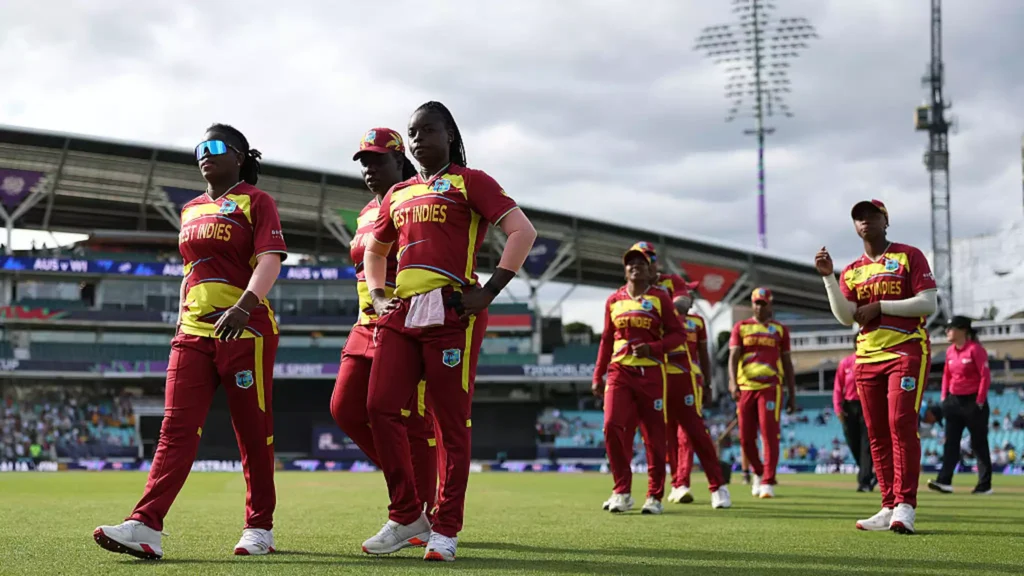
Merit is rarely born in isolation. On Tuesday, Hayley Matthews walked a very thin line between offering the blunt truth and an excuse to make that point.
\”A lot of the time (we) tend to be competing against teams like Australia, who realistically, based on systems and opportunities, we\’re not supposed to beat them,\” she said.
Sports very easily slots – in a very traditional European portrayal – winners and losers as two separate entities after a game; invariably also crafting a contrasting picture for those who came up beating the odds, to others that ride with \’excuses\’. Sporting narratives have historically failed to bridge and accept the two varying concepts as one, preferring less complicated storylines.
Matthews\’ confession had come after West Indies were knocked out of the semifinal of the ongoing T20 World Cup, courtesy a comfortable 8-wicket win by Australia. A good start notwithstanding, West Indies were never really in the contest. For more than half the innings, they cantered along at less than run-a-ball before eventually posting 125 – a target that was chased down with seven overs to spare.
It wasn\’t really a surprise. Australia were overwhelming favourites, and they played like one. They bowled tight lines, not allowing Qiana Joseph to break away; West Indies on the other hand neither pushed for the quick singles nor were they able to muscle big shots past the boundary ropes frequently enough.
Matthews had mentioned before the game that they had nothing to lose, a tag that would allow them to play freely. But that expression of freedom was nowhere to be seen. Three victories to kickstart the campaign were followed by three losses. But Matthews wants her team to leave the tournament with their heads held high.
\”A tournament like this, a lot of other players were able to play a role, and I think that\’s all I can ask for, to see improvements. I certainly feel like a lot of our girls come to a stage to play for West Indies and they have a lot of learning to do on the job. When our players come from our regional competition, they\’re not nearly ready for international cricket ever. And that\’s why players like myself and Stafanie Taylor and Deandra Dottin are so integral in helping them grow.
\”We\’re obviously all disappointed. But I keep reiterating all the time – the fact that we\’ve made it to this stage of the competition with lack of performances from a lot of our big players speaks volumes to the supporting cast that we have in the team and speaks volumes to those like Aliyah Alleyne and maybe a Jahzara Claxton and a Janillea Glasgow.
\”Things used to look a lot different once upon a time, and I certainly feel like the last World Cup or the one before that, if I had the form that I did with the bat and Deandre Dottin did, we would not be in a semifinal right now. So I think we can take a lot of pride from that, knowing that obviously myself and Deandra and Staf, we are part of the team and we are a bit let down, but at the same time you can be so proud of the way that as a unit we were still able to get over the line in a lot of games.\”
To get a perspective on the form of the three senior all-rounders, here\’s a brief breakdown of their contributions in the 55 T20Is West Indies have played since 2023.
Batting
| Runs | Average | Strike Rate | 50s/100s | |
|---|---|---|---|---|
| Matthews + Dottin + Taylor | 3132 | 38.2 | 120.23 | 18/2 |
| Rest of the batters | 3288 | 15.22 | 95.2 | 5/0 |
Bowling
| Wickets | Average | Strike Rate | Economy Rate | |
|---|---|---|---|---|
| Matthews + Dottin + Taylor | 73 | 21.64 | 18.2 | 7.1 |
| Rest of the bowlers | 203 | 27.6 | 23.13 | 7.16 |
The trio has scored 48.8 percent of all the runs the team scored in this phase. Interestingly, it\’s also a period which witnessed the decline of Stafanie Taylor\’s batting as well as her reduced workload as a bowler. During this period, Deandra Dottin had also briefly retired from international cricket.
Matthews calls herself an anomaly, who got the chance to train with the boys while growing up. She defends the rest of her teammates for not getting the adequate opportunities and shed light on a deeper issue.
\”It could be a bit tiring and a lot of pressure sometimes (on me), but at the same time, I don\’t think it\’s necessarily as much the fault of the players coming up. Every single person within the dressing room, they try really hard and they train really hard, and they want to learn and get better. A lot of the time, (we) tend to be competing against teams like Australia, who realistically, based on systems and opportunities, we\’re not supposed to beat them.
\”But we still come here, and I think we show up and we put out some magical performances sometimes. But I do think if we want to stop seeing a dependence on players like myself, it starts from the ground up, from us having programs in place for young girls to learn to play cricket and develop from a young age and not just be the anomaly like myself or Deandra who decided to play with boys when we were 10, 11, 12, 13, to be able to turn out the way that we are now.\”
Matthews says the issue isn\’t about creating another Hayley or Deandra, but keeping a system ready where such players are not anomalies. \”I think it\’s a problem that stems from outside of us and outside of the team, and that\’s why as a player I can\’t necessarily ever be frustrated with girls within the group a lot of the time.
\”You could say it\’s a Cricket West Indies problem, you could say it\’s a money problem. You need a lot of money to do a lot of these things. I think a lot of people know within the West Indies we don\’t always have the funds required. A team like Australia is always going to be better off at being able to put programs in place and have pathways for young girls. And there\’s a lot of different ways you can look at it.
\”But when you go back to the brunt of it, if you\’re struggling for money to do these things, it\’s going to show up at levels like this. And I probably feel like it\’s a bit unfair sometimes. But at the same time, that\’s why it\’s so important. That\’s why you see so much pride and passion within our group because our girls have to fight a lot to even be competing and to be playing at this level. It probably is easy to get into the team, but then when you get to international cricket and you see the standard of it, it can be a really tall ladder to climb to be performing at the standard that you need to.\”
It\’s like the Silicon Valley mythology: that seemingly all billion-dollar start-up success stories begin from garages of geniuses. It might be great for romanticism, but what it conveniently tends to hide is the infrastructure that surrounds it; from world-class universities to venture capital to experienced mentors, the side story behind the success.
Matthews believes that the disparity in the funding received by each country to develop their respective sport has now started reflecting in the performances of the teams, widening the gulf between the haves and the have-nots.
\”It can be very hard sometimes when shares are a lot different for different teams. It makes it really hard for us to compete when we don\’t have pathway programs in place. And then teams like Australia have the greatest pathway system where they\’re pushing out Phoebe Litchfields from 15 years old every single year. Hopefully in the future, we can get more things done, that we can have more young girls being produced and my hope is that we don\’t have a gap now where we see it widen even more.
\”I think the reason that we were so successful back in 2012 and 2013 and 2015 and 2016 is because women\’s cricket was based off of pure talent at that time. And when it\’s based off of pure talent, we\’re always in the run for it. The minute that investment comes into the picture, we\’ve seen the gap widen a lot because of that. Hopefully just conversations like this, and people standing up, able to make a difference… I don\’t know what the answer is, or what direction we go. That\’s probably not even my job, so I\’m not going to worry my head about that too much. But I guess I will sit here and be honest about how it feels.\”